
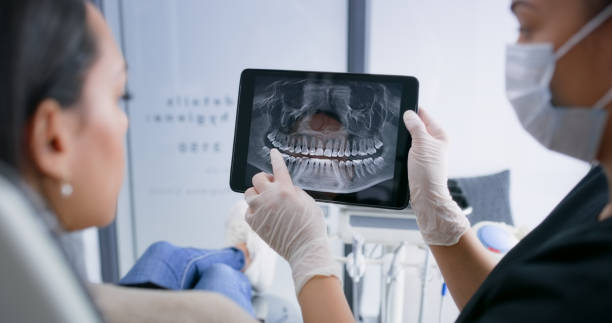
A panoramic X-ray shows exactly how your third molars are positioned before we recommend anything. Smile Center Dentistry assesses impaction type before recommending removal.
Not every wisdom tooth needs removal — we assess each one individually rather than pulling all four by default. A fully erupted, functional wisdom tooth causing no problems can often just be monitored.
We don't rely on a single small X-ray for a decision this significant. This single image gives us a complete picture of all four wisdom teeth at once.
We don't push the most expensive sedation option by default — we recommend based on your actual case. We'll tell you honestly if your case would benefit from a higher sedation level.
We classify each wisdom tooth's impaction type, since that determines procedure complexity and recovery time. Classification happens per tooth, since it's common for one side to differ from the other.
You'll know realistic swelling and downtime expectations before surgery day, not discover them afterward. We'd rather set an accurate expectation than have you surprised by how you feel on day two.
Every wisdom tooth case is different depending on position and impaction type — here's what's typically involved.
A single panoramic image shows all four wisdom teeth, root position, and proximity to nerves. We review the image with you directly, pointing out what we're seeing.
When a tooth has erupted but gum tissue partially covers it, removal is usually more straightforward. We explain why your case falls into this category if it does.
When a tooth is angled or fully encased in bone, removal requires a more involved surgical approach. Recovery expectations are set honestly for these more involved cases.
Local anesthesia, oral sedation, or IV sedation are all discussed based on your anxiety level and case complexity. Pre-procedure instructions for sedation are given clearly in advance.
A follow-up check confirms healing is on track, especially for more complex bony impaction cases. We're reachable directly if recovery doesn't feel right.
When a wisdom tooth is fully erupted and functional, we may recommend monitoring rather than removal. If circumstances change, we revisit the removal conversation honestly.
We ask about symptoms — pain, swelling, crowding — to prioritize scheduling appropriately.
We image all four wisdom teeth and classify impaction type for each one individually.
Simple cases may take under an hour; complex bony impactions take longer.
We're reachable directly during recovery if swelling or pain seems unusual.
"Only needed two of the four removed — they explained the other two weren't causing problems instead of pulling all four by default."
"Went with oral sedation since I'm anxious about dental work. They walked me through what to expect beforehand."
"Swelling peaked around day two exactly like they said it would. No surprises during recovery."
"They classified each tooth individually instead of treating it as one generic 'wisdom teeth out' procedure."
"Told me one of my wisdom teeth was fine to keep and monitor instead of removing all four automatically. Saved me an unnecessary procedure."
Not necessarily — we assess each tooth individually and only recommend removing the ones actually causing or likely to cause problems. We'll show you the panoramic X-ray and explain our reasoning for each tooth.
Local anesthesia, oral sedation, and IV sedation are all options, chosen based on impaction complexity and your comfort level. Cost and recovery from sedation itself factor into which option makes sense for you.
We give a realistic timeline specific to your impaction type, not a generic estimate. We schedule a follow-up to confirm healing is on track for your specific case.
Some patients need evaluation later if problems develop, regardless of age. Earlier evaluation sometimes means an easier procedure, since roots are less developed.
Pain, swelling, difficulty opening your mouth, or crowding of nearby teeth are all signs worth getting imaged soon. Don't wait for severe pain — earlier evaluation usually means easier treatment.
Cost depends on impaction type and how many teeth are involved — we quote this after your panoramic X-ray. We verify insurance benefits before treatment so you know your out-of-pocket cost.
Our team serves Clearview and the surrounding zip codes with the same impaction-specific assessment at every visit. We coordinate with oral surgery resources for the most complex bony impaction cases, so a referral stays close to home.
We'll tell you honestly which teeth actually need to come out.
Call +1-866-227-2801